
In 2026, the modern GTM stack replaced the legacy one across five layers.
- CRM: HubSpot took the SMB and mid-market crown from Salesforce.
- Data enrichment: Clay's coordination engine displaced ZoomInfo's single-database model for custom ICPs.
- Sales engagement: Smartlead, Instantly, and Amplemarket pulled outbound-led teams away from Outreach and Salesloft.
- Intent: custom Clay-built signals are replacing opaque 6sense and Demandbase scores.
- SDRs: hybrid AI + human is the working pattern; pure-human teams and pure-AI teams both underperform it.
Below: what changed in each layer, named tools, sourced costs, and the verdicts we'd give a client today.
What "legacy" and "modern" actually mean in 2026
The categories aren't about age. Salesforce in 2003 was modern. Outreach in 2015 was modern. Both are now legacy — not because they got worse, but because the operating assumptions shifted underneath them.
Legacy GTM tools share four traits:
- Per-seat pricing. You pay per rep, per inbox, per dialer license. Costs scale with headcount, which made sense when revenue scaled with headcount. It doesn't anymore.
- Depth-of-feature. Every workflow is configurable. Every screen has a toggle. The product is rich, the implementation is six months, and most features go unused.
- Enterprise sales motion. You don't buy them, you procure them. MSA, security review, multi-year contract, named account team. The friction is the moat.
- Opaque AI. "Predictive scoring" is a black box. The number changes; nobody explains why.
Modern GTM tools share four different traits:
- Flat-fee or usage-based pricing. Unlimited inboxes for a fixed monthly fee. Credit-based enrichment. Per-task billing for AI agents. Costs scale with output, not headcount.
- Workflow over feature depth. The product is a coordination engine. Deliberately thin on opinions, deep on extensibility.
- Self-serve or community-led. You sign up, find a Slack community, watch a Loom, and deploy. There's a sales team somewhere, but you can ignore it.
- AI-native with provenance. Every AI-generated field shows you which model, which prompt, which source data. The math is visible.
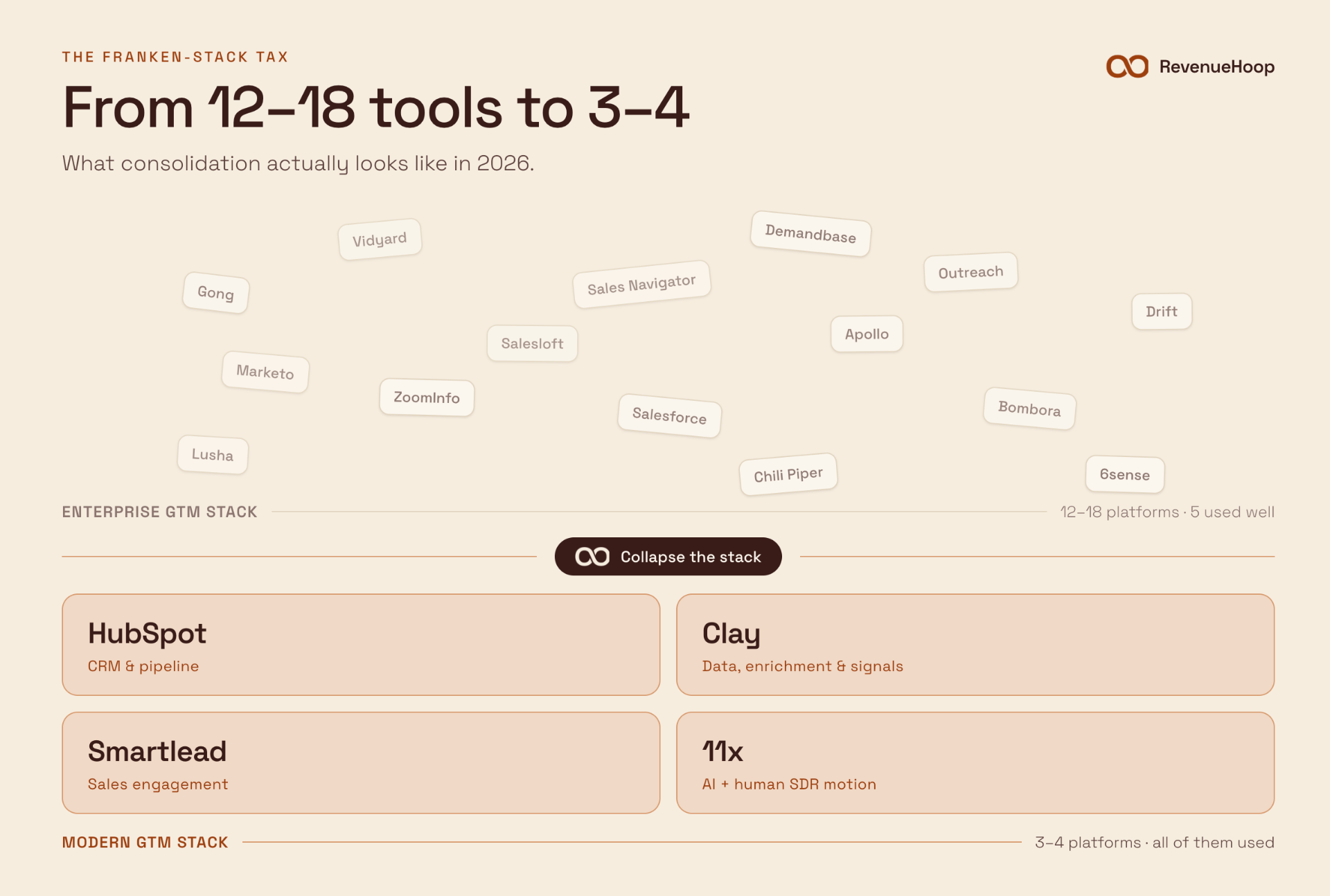
The other shift driving the migration: the franken-stack tax. Enterprise revenue teams typically manage 12–18 GTM platforms today, most of which overlap and few of which talk to each other (RevOps Tools, 2026 analysis). Modern teams are consolidating to 3–4 tightly integrated platforms. Sales reps lose roughly 60% of their week to non-selling tasks inside legacy stacks (Landbase, 2026). That's not a productivity problem — it's an architecture problem.
The five layers, by name
Strip the marketing labels and the modern GTM stack reduces to five functions:
- CRM — the system of record. Where every account, contact, deal, and signal terminates.
- Data enrichment — who this person is, what they buy, when they buy, what they care about.
- Sales engagement — sequencing, sending, and tracking outbound at scale.
- Intent + signals — who is in-market right now, and why we think so.
- SDR motion — who actually does the outreach work (humans, agents, or both).
Every other tool in your stack is either a sub-component of one of these layers (a dialer is sales engagement; a data provider is enrichment) or a reporting layer on top (Looker, Mode, Tableau).
The mapping isn't always 1:1. A modern team running HubSpot + Clay + Smartlead + 11x covers the same five functions as a legacy team running Salesforce + ZoomInfo + Outreach + Bombora + a six-SDR pod, with fewer integrations to maintain and meaningfully lower total cost.
Layer 1 — CRM: Salesforce → HubSpot (for most teams under $50M ARR)
The legacy case (Salesforce)
Salesforce still holds the CRM market crown. IDC pegs its global share at ~20.7%, and Salesforce reported ~$41.5B in FY26 revenue — roughly 13× HubSpot's revenue base. In large enterprise and regulated verticals, it remains the default: deep customization through Apex, Service Cloud + Marketing Cloud + Data Cloud as a unified data fabric, and procurement teams that already know how to buy it.
What Salesforce isn't, anymore: the obvious choice for a 30-person SaaS company doing $10M ARR.
The modern case (HubSpot)
HubSpot serves 288,706 paying customers — almost 2× Salesforce's ~150,000. The companies live in different revenue brackets, but the customer-count gap has been growing for years. HubSpot is growing 20–25% YoY against Salesforce's 8–11%, and the SMB-and-up segment has effectively consolidated onto it.
Two things drove the shift after 2022:
- HubSpot got real enterprise features. Custom objects, advanced reporting, sandbox environments, role-based permissions. The "HubSpot is a marketing tool" framing stopped being accurate.
- The two-system tax got expensive. "HubSpot for marketing, Salesforce for sales" used to be the standard. Then mid-market companies did the math on duplicate seat costs, integration maintenance, and data-sync edge cases — and consolidated.
Verdict — when to choose which
Use HubSpot if: under $50M ARR, you want one platform for marketing + sales + service, your team is under ~100 reps, and you don't have a dedicated Salesforce admin in-house.
Use Salesforce if: regulated industry (healthcare, finance, defense), multi-cloud requirements, custom Apex needs, procurement that already approved it, or revenue team over ~150 people.
This is the highest-stakes layer to migrate — changing CRM mid-flight is expensive in ways that don't show up until month four. Most teams should pick once and live with it for at least three years.
Layer 2 — Data enrichment: ZoomInfo → Clay (for custom ICPs)
The legacy case (ZoomInfo)
ZoomInfo built one of the most authoritative B2B databases on the market over twenty years. The bet was simple: own the data, control quality, charge for access. For North American B2B with mainstream ICPs, the data is still strong.
The pricing reflects the model. Enterprise contracts run $25K–$40K/year, implementation is 4–8 weeks, and the procurement story is clean: one vendor, one data source of truth, one throat to choke.
The modern case (Clay)
Clay took the opposite bet. Instead of owning a single database, build a workflow engine that orchestrates 150+ data providers — including ZoomInfo itself — into custom enrichment cascades per ICP, per use case, per account.
The market is voting with capital. In August 2025, Clay closed a $100M Series C at a $3.1B valuation, led by Alphabet's growth fund CapitalG. That's a 6× valuation jump in roughly 14 months, from ~$500M to $3.1B.
The architectural shift this enables is the waterfall: instead of accepting whatever one database returns, Clay queries multiple providers in sequence (or parallel) and stops when it finds a result that passes your validation rules. For niche ICPs, EU contacts, technical-buyer accounts, or anything where one database has known coverage gaps, the waterfall produces materially better data quality than any single source.
Clay starts at roughly $2,000/year for the entry tier.
We're a Clay First 100 Solutions Partner. We've deployed Clay waterfalls for clients across HR Tech, FinTech, and DevTools — most recently rebuilding enrichment from a single ZoomInfo source into a 5-vendor waterfall that lifted email coverage from ~62% to 91% on the same target list.
Verdict
Use Clay if: custom or niche ICPs, EU/APAC contacts, ABM-style "every account needs different enrichment," or you want explainable provenance per field.
Use ZoomInfo if: procurement requires single-vendor, North American B2B mainstream ICPs, or you want one integrated suite (data + intent + engagement + conversation intelligence).
Use both: most modern stacks do. Clay orchestrates ZoomInfo as one of several sources. The two aren't mutually exclusive — they're at different layers of the same problem.
Layer 3 — Sales engagement: Outreach / Salesloft → Smartlead / Instantly / Amplemarket
This is the layer where 2025–2026 changed fastest.
The legacy case (Outreach + Salesloft)
Salesloft (founded 2011) and Outreach (founded 2014) defined the sales engagement category. They built it: cadences, automated dialers, integrated email + phone + LinkedIn, native Salesforce sync, enterprise admin controls. For a decade, "sales engagement" and "Outreach or Salesloft" were synonyms.
Then the operating assumptions shifted, and both companies absorbed a series of hits in the same 18 months:
- Both founders left. Kyle Porter departed Salesloft in 2023; Manny Medina exited Outreach in 2024. The visionary product DNA went with them.
- Salesloft + Clari merged in late 2025, creating a combined entity with ~5,000 customers and a reported ~$10T in revenue under management. Mergers of this size usually signal market consolidation, not market growth.
- The Salesloft Drift cybersecurity breach (late 2025) forced temporary product shutdowns and led Salesforce to disconnect Salesloft integrations from its native marketplace — a remarkable move from a vendor whose ecosystem health is part of the value prop.
The modern case (Smartlead, Instantly, Amplemarket)
The challengers came in from a different angle. Rather than reinvent sequencing, they rebuilt deliverability as the moat.
Smartlead and Instantly both ship flat-fee unlimited-inbox pricing — a structural break from Outreach/Salesloft's per-seat model. For high-volume outbound, the math is incomparable: you're not paying per rep, you're paying per platform, and the inboxes are just rented infrastructure.
Amplemarket went further, building unified intelligence + sequencing + AI agents in one platform. Less "sequencing tool," more "outbound operating system."
The deliverability angle isn't marketing. Domain reputation, inbox warmup, send-pattern variance — these moved from "nice to have" to "the actual moat" sometime in 2024 when Google and Microsoft tightened spam classifiers in lockstep. A clever sequence on a burned domain lands in spam. A boring sequence on a healthy domain lands in inbox. The modern platforms are bets on the second half of that sentence.
Verdict
Use Smartlead or Instantly if: outbound-led motion, agency or scale-up, high volume, deliverability is your bottleneck, and you can think in terms of domain rotation + inbox infrastructure.
Use Amplemarket if: you want one platform for intelligence + sequencing + AI assistance, fewer integrations, AI-native from the ground up.
Use Outreach or Salesloft if: enterprise sales engagement (not outbound), you need multi-channel dialing + LinkedIn + email in one rep view, you have ops resources to maintain it, and procurement requires a "Gartner Magic Quadrant" vendor.
The "use Outreach for outbound" case is genuinely thin in 2026. For pure outbound-led pipeline gen at scale, the modern platforms win on both cost and deliverability.
Layer 4 — Intent + signals: opaque scores → custom Clay-built + 1st-party
The legacy case (6sense, Demandbase, Bombora)
The intent-data category emerged from a real insight: most B2B buyers do most of their research before talking to vendors, and external signals (content consumption, search behavior, vendor evaluation activity) can predict in-market status. 6sense and Demandbase built large businesses on this.
Pricing reflects how the category sells: 6sense median contracts run ~$58,950/year, ranging $10K–$155K; Demandbase typically prices 30–50% cheaper but climbs higher on the enterprise end ($300K+). On Gartner Peer Insights, 6sense rates 4.7/5 (17 reviews); Demandbase 4.2/5 (71 reviews). They're well-built products.
What they're not, in 2026: explainable. The scores are black boxes. Reps don't trust them because they can't see the math. Marketing teams optimize against them because they're the only number available. The gap between "what the score says" and "what the rep observes" is where pipeline goes to die.
The modern case (custom Clay-built signals + 1st-party tools)
The modern alternative is two tools running in parallel:
- Custom Clay-built signals — define the signal logic explicitly, weight it transparently, surface it in CRM with explanation. "This account scores 78 because: champion changed companies (+25), funded in last 90 days (+15), 4 visits to /pricing in last 7 days (+18), competitor uninstall reported (+20)." Reps trust scores they can explain to their managers.
- 1st-party tools like HockeyStack, Common Room, and RB2B — surface signals from your own properties (website, product, community) rather than 3rd-party crawled data. The data quality is much higher because you own the source.
The hybrid reality
Most modern stacks still use 6sense or Demandbase for breadth — wide-net intent coverage across thousands of accounts — and layer custom signals for precision in the top tier of named accounts. The two solve different problems.
Verdict
Use 6sense if: large NA SaaS (>$50M ARR), you have ops capacity to operationalize predictive scores, your buyer profile matches what their data covers well.
Use Demandbase if: enterprise account research depth matters more than predictive AI, you sell into non-tech verticals, or you want stronger website personalization.
Use Clay-built custom signals if: you want explainable signal logic in front of reps, your ICP is niche enough that vendor scores don't match well, or you want signals tied to your own events (champion job changes, product usage drops, etc.).
The hybrid: keep 6sense or Demandbase for top-funnel breadth; build custom signals in Clay for the top 20% of accounts. This is what we deploy for clients.
Layer 5 — SDR motion: pure-human → hybrid AI + human
The legacy case (pure-human SDR team)
The classic model: 1 AE supported by 2 SDRs, with SDRs doing research + first-touch outreach + qualification. Fully loaded SDR cost runs $75K–$110K/year once you include comp, benefits, tooling, management overhead, and ramp time.
The model worked when (a) outbound was the dominant pipeline source, (b) volume was the lever, and (c) AI couldn't do research. None of those are clean assumptions anymore.
The modern case (AI SDR tools: 11x, Artisan, and the long tail)
A wave of AI SDR platforms launched in 2024–2025 promising to replace human SDRs end-to-end. The pitch: an autonomous agent that researches, personalizes, sequences, and replies — at a fraction of the cost.
11x is the category leader by mindshare. Pricing runs roughly $1,230–$5,000/month on mandatory annual contracts, with the commonly quoted package around $5K/month for ~3,000 leads. The company reports a 1.5× lift in qualified meetings against unaided benchmarks. Vendor-reported, so weigh accordingly.
Artisan competes on accessibility — entry pricing from ~$250/month, faster SMB deployment. The Artisan billboard campaign ("Stop hiring humans") got attention; the product is a real working AI SDR with built-in data.
The honest caveat
Industry coverage suggests 50–70% of AI SDR tools churn within a year. Caveat on that source: Unify GTM is a competitor in the space, so the number has motivated bias — but the directional point holds, and we've seen it in client engagements. AI SDRs underperform when they:
- Hallucinate context from scraped LinkedIn profiles
- Miss buying signals that aren't in the public web
- Generate emails that "sound personalized" but aren't actually relevant
- Can't escalate complex replies to humans cleanly
The working hybrid
What we deploy for clients in 2026:
- AI handles: account + persona research, first-draft personalization, sequence cadence, low-stakes follow-up
- Humans handle: reply triage, qualification calls, complex objections, deal advancement
- Cost structure: ~1 human SDR for every 3–5 AI-augmented workflows, instead of 2 SDRs per AE
This isn't the future; it's the operating standard for top performers right now.
Verdict
Use AI SDRs (11x, Artisan, etc.) if: top-of-funnel research and first-touch personalization at scale, paired with a human reviewer who handles replies. Not as a "replace the team" play.
Use pure-human SDR if: complex enterprise deals, regulated industries, $50K+ ACVs, or relationship-led sales motion.
The hybrid (which is what works): AI agents at the top of the funnel, humans at the qualifying-and-closing layer, tight feedback loops from human to AI so the agents learn the ICP over time.
Where legacy still wins
Not every layer has flipped. Honest read of where legacy tools still beat modern ones:
- Enterprise procurement. SOC 2 Type II, MSAs, multi-year contracts, named account team, dedicated CSM. Procurement teams are paid to reduce vendor risk, and a 20-year-old public company carries less perceived risk than a Series C startup. This matters more than RevOps people like to admit.
- Regulated verticals. Healthcare, financial services, government, defense. The compliance lift on Salesforce + Outreach is already done. The compliance lift on Clay + Smartlead is your team's problem.
- Multi-cloud architectures. If you're running Salesforce Service Cloud, Marketing Cloud, and Data Cloud as a unified fabric, ripping the Sales Cloud component out is a structural migration, not a tool swap.
- Brand permanence. "Nobody got fired for buying Salesforce" is still a real psychological reality in some boardrooms. If your CFO or board would push back on a Clay procurement, that resistance has a real cost.
The takeaway isn't that legacy is obsolete. It's that modern won the layers where flexibility, cost, and AI-nativeness matter most — and legacy still wins the layers where procurement, compliance, and risk-aversion matter most.
How to decide which layer to upgrade first
You don't rebuild the whole stack at once. The right migration order depends on (a) where the pain is loudest and (b) where the TCO swap pays back fastest.
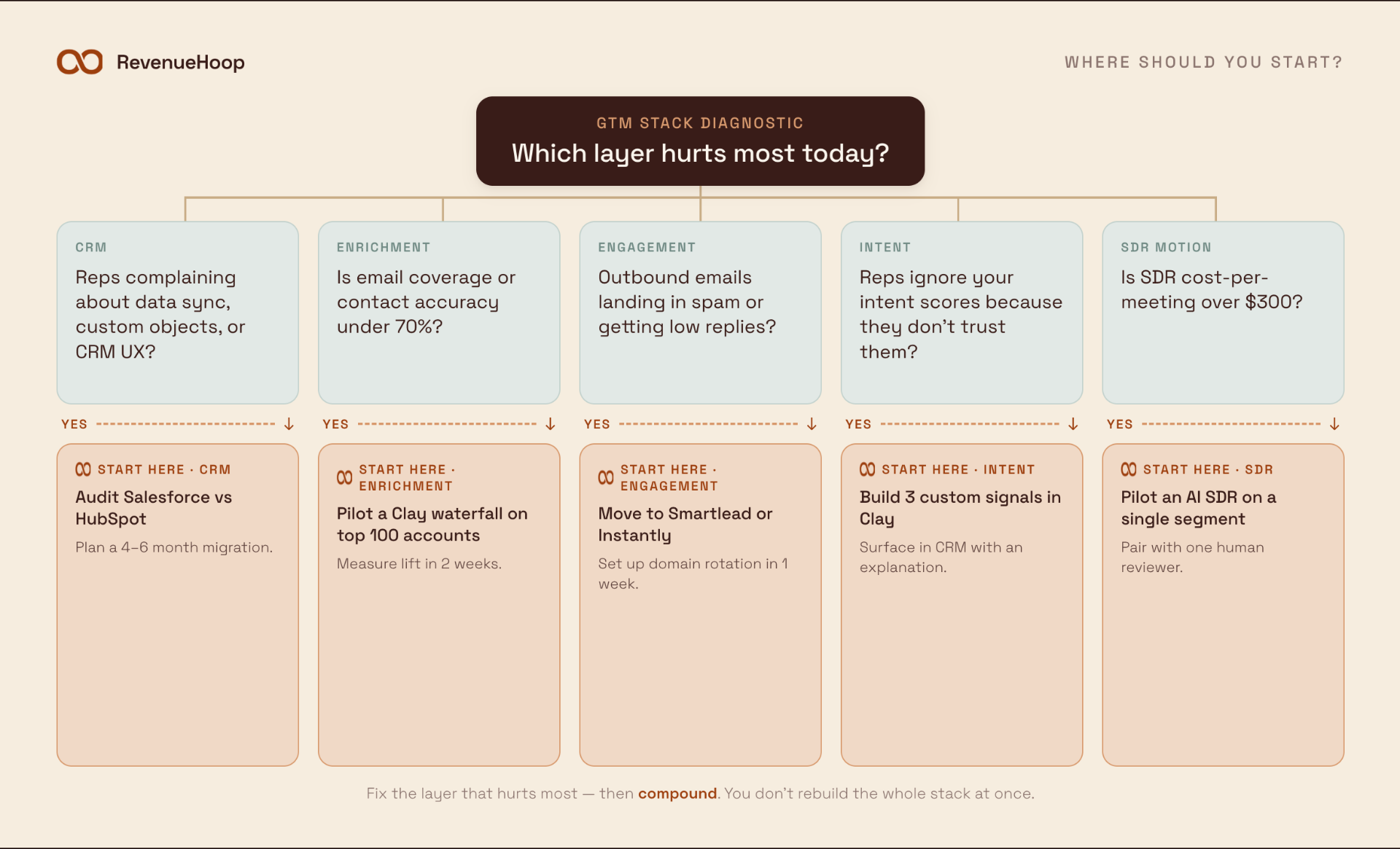
Three operating rules underneath the decision tree:
- Lowest TCO swap, highest leverage first. Enrichment and engagement are usually the cheapest swaps with the fastest visible lift. CRM is the most expensive swap with the slowest payback — do it once, do it right.
- Match the layer to your loudest bottleneck. If reps complain about data quality, fix enrichment first. If sends aren't landing, fix engagement. If forecasts are wrong, fix CRM or RevOps process. Don't optimize the layer that isn't your bottleneck.
- Don't run two CRMs in parallel "for safety." It feels safer; it isn't. Pick one, migrate clean, deprecate the old one within 90 days.
What this actually means for RevOps teams in 2026
- Audit your stack against the 5 layers. Count how many tools you're paying for in each layer. If any single layer has more than 2 tools, you have integration tax — it's best to consolidate.
- The cost of "and" beats the cost of "or." Most modern tools cost less per year than the cost of not integrating a legacy stack. The math isn't close when you include ops engineering time.
- AI cost is collapsing. Tool prices are dropping by 30–50% per year on the modern end. Don't sign a 3-year contract on anything in this space unless there's a real reason.
- Build for the next 18 months, not the next 5 years. Your architecture should be modular enough that swapping one layer doesn't require rebuilding all the others.
- Operator judgment beats vendor pitches. The vendors with the largest sales teams are usually the legacy ones. If you're only seeing the slick demo, you're seeing the legacy stack. Talk to other operators running modern.
FAQs
How many tools should a modern RevOps stack have?
3–4 tightly integrated platforms, down from the enterprise average of 12–18. The exact tools depend on motion and segment, but the count discipline is consistent across high-performing teams.
Is Salesforce still relevant in 2026?
Yes, but mostly for enterprise (>$50M ARR), regulated industries (healthcare, finance, defense), and multi-cloud Salesforce architectures. The SMB and mid-market segment has largely consolidated onto HubSpot, which now serves ~2× the customer count and grows ~2.5× faster.
Should we switch from ZoomInfo to Clay?
Depends on ICP. Clay wins for custom or niche ICPs, EU/APAC contacts, and ABM motions where every account needs different enrichment. ZoomInfo wins for North American B2B mainstream ICPs and single-vendor procurement. Many teams use both — Clay orchestrates ZoomInfo as one of several data sources in a waterfall.
Are AI SDRs replacing human SDRs?
No. Industry data suggests 50–70% of AI SDR tools churn within a year (Unify, 2026). The working pattern in 2026 is hybrid: AI handles research and first-touch personalization, humans handle reply triage and qualification. Pure-AI underperforms; pure-human is increasingly cost-inefficient at the top of the funnel.
What replaced Outreach and Salesloft for outbound-led teams?
Smartlead, Instantly, and Amplemarket. All three ship flat-fee unlimited-inbox pricing instead of per-seat, and prioritize deliverability infrastructure (domain rotation, warmup, send-pattern variance) over sequencing UX. Outreach and Salesloft remain strong for enterprise multi-channel sales engagement; they're no longer the right call for outbound-led pipeline gen.